How It Was Written
The Process
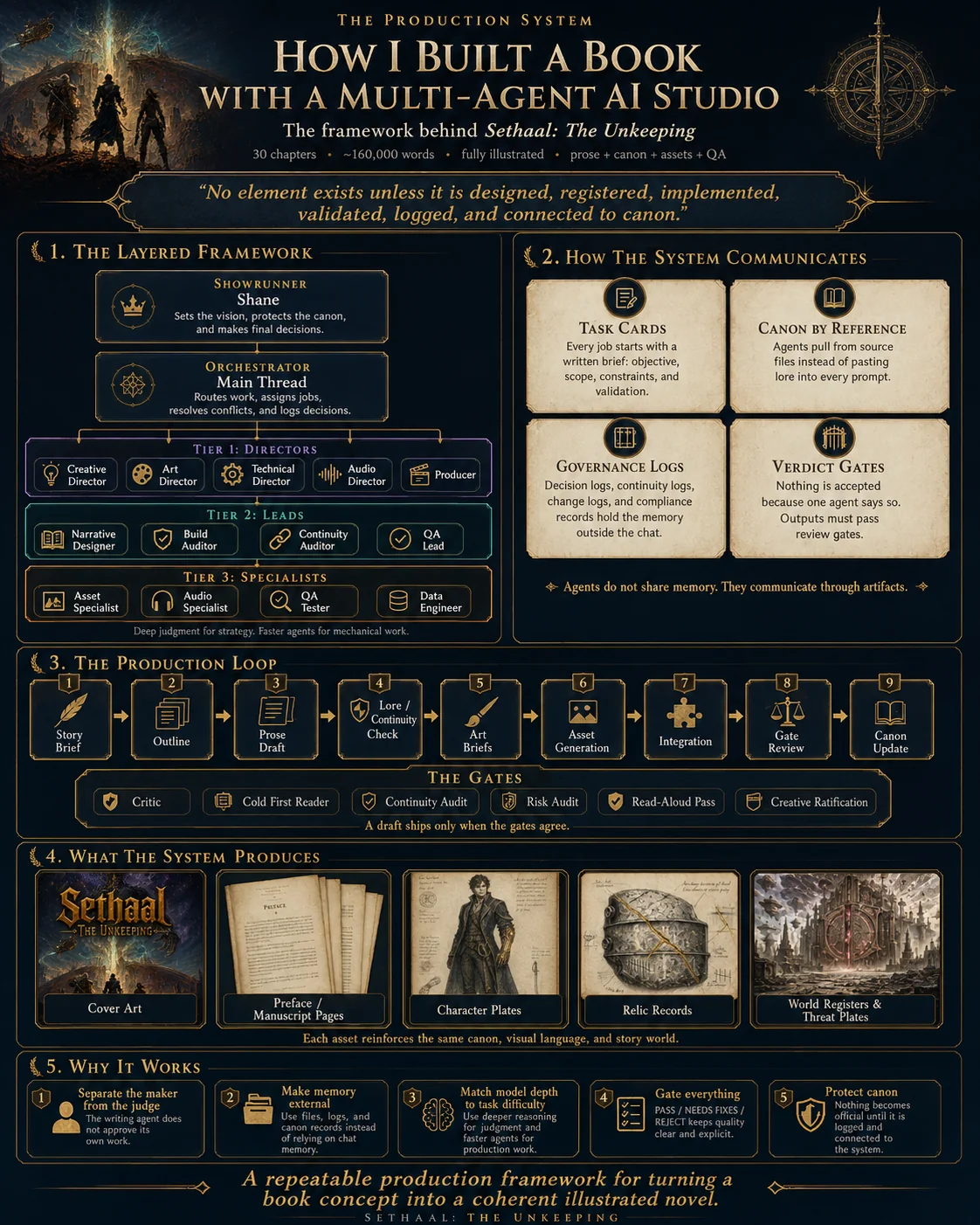
I built this book with AI. The interesting part is not that a model generated the words — anyone can do that. The interesting part is the system that kept a hundred and sixty thousand AI-generated words from collapsing into incoherent drift. I did not treat it like a chatbot. I treated it like a studio.
One rule sat above everything. It is the thing that turns generation into production:
“No element exists unless it is designed, registered, implemented, validated, logged, and connected to canon.”
The layered team
A roster of specialized agents, each with one job. Directors who own the story and the canon, a writer, a critic, a continuity auditor, specialists who make the art. One orchestrator runs the floor — it dispatches the right agent, routes the work through the gates, brokers disagreements, and logs every decision. It never writes a word of the book itself. The moment the conductor picks up an instrument, the orchestra falls apart.
How they communicate
Here is the part most people miss: the agents do not share memory. Each one runs in its own isolated context and forgets everything the moment it finishes. So they cannot talk — they communicate through artifacts. Task cards carry the handoffs. Canon is referenced by file, never pasted, so the world cannot drift. The governance logs are the project's memory, living outside any single agent. And every output is graded by a different agent before it counts.
The production loop, and the gates
Every chapter ran the same pipeline, ending where it mattered most: the gates. Before a chapter survived, it was attacked from every side — a critic held to a literary-award standard, a cold first-reader who was never allowed to see the rules, a continuity auditor, a risk audit, a read-aloud pass, a final ratification. The orchestrator brokered the verdicts. A chapter shipped only when every gate read clean. When the critic and the writer disagreed, it became a literal prosecution and defense.
Why it works
Four things, if you want to build your own. Separate the maker from the judge — the agent that writes never grades its own work. Make memory external — agents forget, so the memory lives in files, not the chat. Route by cognitive load — the deepest model for judgment, the fastest for mechanical work. And gate everything with a hard verdict: pass, needs-fixes, or reject. “Looks good” is not a verdict.
The book is about ancient systems that failed because people dug too fast and too recklessly. The system that built it had to be the opposite: map the seal, document the risk, open one chamber at a time, and verify the structure still holds.